
First, the part that decides whether you need to read on. Digital invoicing applies to sales-tax-registered persons. If you hold an STRN, you are in scope. If you run a shop that has never been registered for sales tax, this is not your deadline, and no vendor should be selling it to you as one.
For everyone holding an STRN, the rules arrived in stages. Chapter XIV of the Sales Tax Rules 2006 was substituted by SRO 69(I)/2025 on 29 January 2025. SRO 709(I)/2025 in April set the first dates, 1 June 2025 for corporate registered persons and 1 July 2025 for non-corporate. SRO 1852(I)/2025 in September then phased the rest in by turnover, with the last band covering all remaining registered persons from 31 December 2025. From 1 July 2026, the Finance Act 2026 lets the Commissioner suspend or blacklist the registration of a person who is not integrated.
Dates and penalty figures have been revised more than once. Confirm your own position with FBR or your tax advisor, not with a blog post, ours included.
Why your buyers will push before FBR does
An invoice issued outside the system is not a valid sales tax invoice. That is not only your problem. Your registered buyer cannot claim input tax against it, which turns your compliance into their loss.
In practice that is what forces the issue. A distributor with a suspended supplier stops buying from that supplier, because every purchase costs them the tax they can no longer reclaim. If you sell business to business at all, expect the pressure to arrive from your customer before it arrives from an officer.
The problem: integration stalls on data, not on software
Connecting is the easy half. PRAL provides integration free of cost, and licensed integrators do the same commercially. What actually delays businesses is that their own records were never kept to the standard a machine-readable invoice needs.
A hand-written invoice tolerates "Shirt, 2 pcs, 3000". A digital invoice submitted to a government system does not. It needs the seller identified, the buyer identified, each line described with its own code and its own tax, and an invoice number that is unique and unbroken. The system returns a centrally generated invoice number and a QR code, and it returns them only if the payload passes validation.
Most shops fail on at least two of the four below, and they find out during integration week, which is the worst possible time.
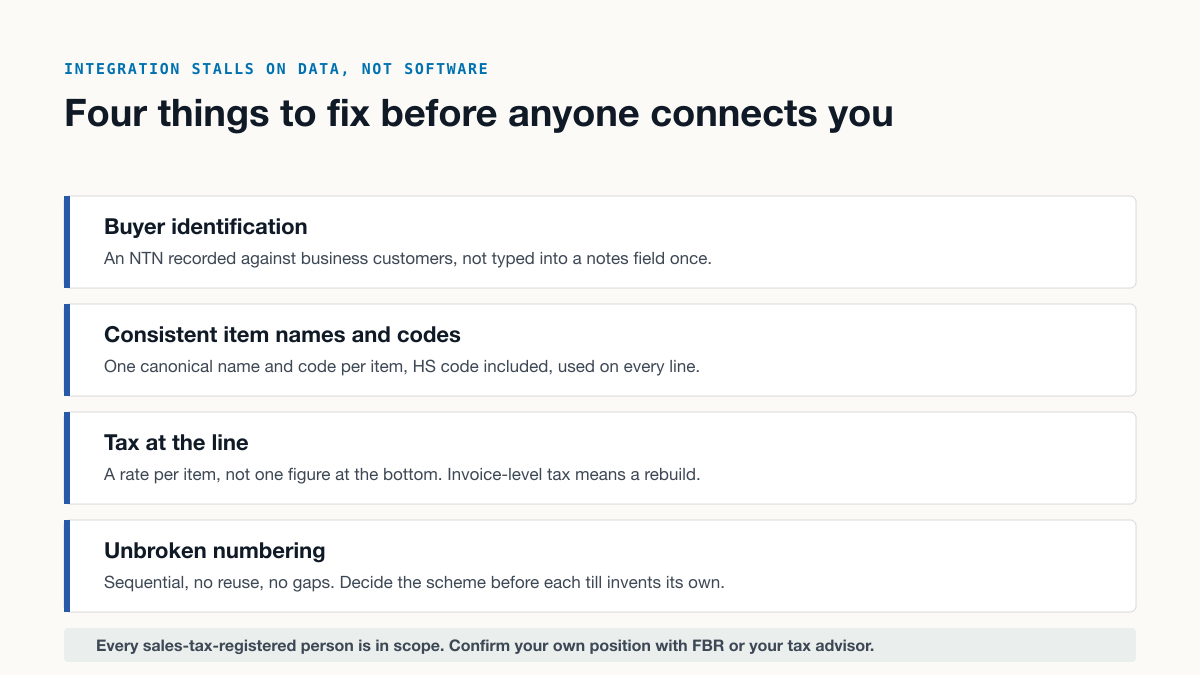
The four things to fix now
Buyer identification. Registered business customers need an NTN or STRN recorded against them as a field, not typed into a notes box once and forgotten. If you sell B2B at all, go through the customer list and fill the gaps. This is slow, boring, and it is the most common reason a first submission comes back rejected.
Consistent item names and codes. "Chino 32", "chino-32" and "Everyday Chino size 32" are one product typed three ways. A person understands that. A validation rule does not. Every item needs one canonical name and one code, and the payload carries an HS code per line, so somebody has to decide those and record them once rather than guessing per invoice.
Tax at the line, not at the total. If your current invoice applies one tax figure at the bottom, you are looking at a rebuild rather than a setting. Digital invoices carry a rate against each line, because different items can carry different rates. Check whether your system stores a tax rate against the product. If it stores one rate against the invoice, that is a real gap and it is better found now.
Unbroken invoice numbering. Sequential, no reuse, no gaps you cannot explain. If you restart numbering every year, or every counter keeps its own pad, decide the scheme centrally before integration rather than after.
How to score your own readiness in an hour
Export one month of invoices to a spreadsheet. Count the blanks in four columns: buyer NTN, item code, per-line tax rate, invoice number. The count of blank cells is your readiness score, it costs an hour to produce, and it is more honest than any vendor's checklist.
Then fix the entry point before you fix the history. Make the NTN field required for business customers today. A clean-up corrects the past once. A required field stops the problem coming back while you are still cleaning.
Five things worth knowing before you start
Start with your top fifty customers. The B2B accounts that need an NTN are a small slice of your list and most of your invoice value. Fix those and you have covered most of your exposure.
Ask your integrator for their field list in writing, early. Their required fields are your checklist. Getting them two weeks before go-live instead of during it is the whole difference between a configuration job and a scramble.
PRAL is free. Integration through PRAL costs nothing, and FBR charges no fee for integration. If somebody is quoting you a large figure to "register you with FBR", ask exactly what the money buys.
Test with your real messy data, not with a clean sample. A sample invoice always passes. Your actual month of invoices, with the missing NTNs and the three spellings of one product, is the test that tells you something.
Keep your own copy of everything you submit. Whatever the integration does, your records stay your responsibility, and the day you need to prove something is not the day to discover you only have somebody else's portal.
Where Modventrix stands, plainly
Modventrix does not submit invoices to FBR's system, and we are not a licensed integrator. What we do hold is the data: a tax number against each customer and your own NTN on the business profile, a tax rate and tax amount on every invoice line rather than one figure at the bottom, invoice numbers drawn from one sequence per business with duplicates refused outright, and an export of any of it.
That is data readiness, not filing. If integration is a legal requirement for you today, you need a package built around it or a licensed integrator working alongside whatever you use for stock and sales, and we would rather say that here than let you find out after paying us. It is the same answer we gave in our guide to what inventory software costs in Pakistan, and becoming an urgent topic has not changed it.
Ask any vendor claiming to be "FBR ready" what that phrase means in their case, whether they file or only format, and get the answer in writing.
The part that is true whatever your date turns out to be
Nobody can tell you your position from a blog post. What holds regardless is that the businesses which integrate smoothly are the ones whose customer records, item codes, per-line tax and invoice numbering were already in order. That work pays for itself even if your date moves again, because it is the same work that makes your own reporting worth trusting.