
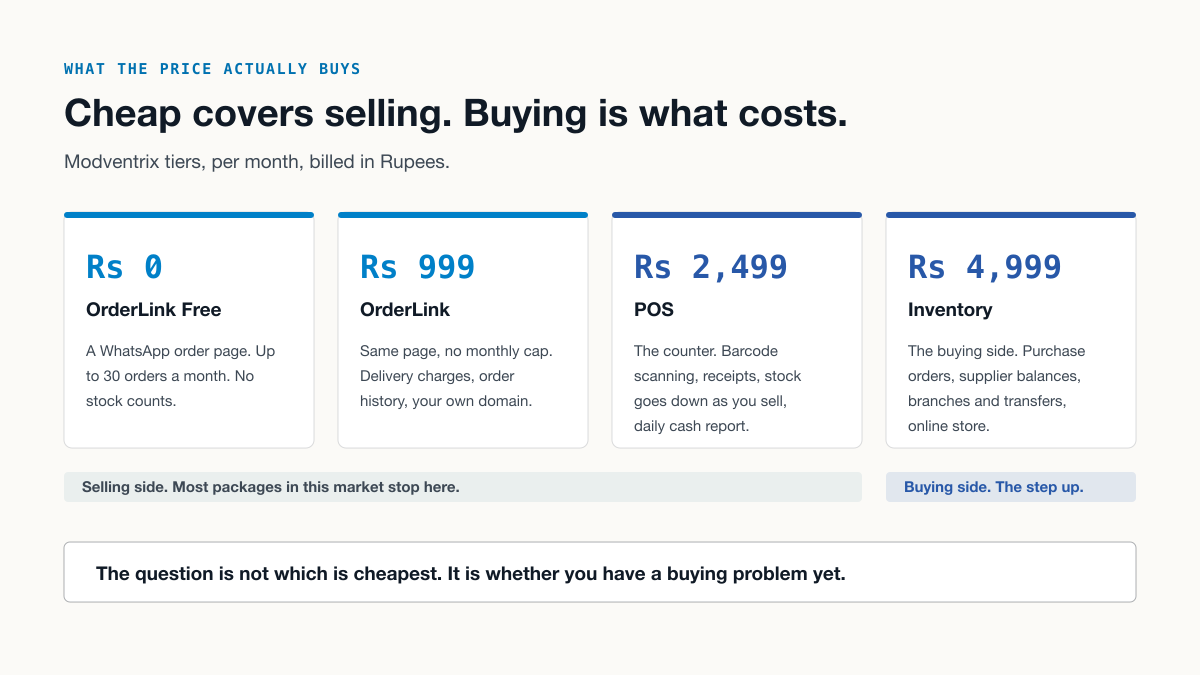
Every price you will be quoted in this market is a monthly figure, and every monthly figure hides the same question: which half of your business does it cover. Selling is cheap to build. Buying is not.
Here are the bands as they stand in 2026, what sits inside each one, and the honest test for which one you need.
What people are actually paying
| What you are buying | Typical monthly cost |
|---|---|
| A WhatsApp or Instagram order page | Free to about Rs 1,000 |
| A counter till, one shop | Rs 2,000 to Rs 3,000 |
| Inventory with purchasing and branches | Rs 4,000 to Rs 6,000 per branch |
| International cloud tools | $29 to $69 per terminal, billed in dollars |
Two things about that last line. It converts to somewhere between Rs 8,000 and Rs 20,000 a month at today's rate, and because it is billed in dollars your software cost moves every time the rupee does. That is a real problem when you are budgeting a shop in Rupees, and it is the single most common reason businesses here leave an international tool after a year.
Why the cheap ones are cheap
Almost everything under Rs 3,000 covers the selling side. Billing, a stock count, a counter, maybe a report of the day's takings. That is genuinely useful, and for a shop with one counter and two suppliers it is enough. Do not let anyone tell you otherwise.
What that price does not cover is buying. Purchase orders raised before the rate is agreed, goods received against them line by line, the short delivery that arrives as 294 of 300, and a running balance per supplier so you know what you owe without opening a diary. In wholesale and in anything imported, that is where the money is actually made and lost.
The second thing that costs more is real multi-location stock. Not a location field typed on a product, but separate quantities per branch, transfers between them, and reports that keep branches apart instead of adding them into one number that hides which shop is failing.
If a quote at Rs 2,500 and a quote at Rs 5,000 look like the same product to you, ask each vendor to show you a purchase order being received short. The difference becomes obvious in about ninety seconds.
Which tier you actually need
You sell through Instagram and WhatsApp, and hold little stock. Use a free order page. Paying for inventory software before you have an inventory problem is the most common mistake we see, and we would rather say so now than take the money.
You have one shop, one counter, and buy from one or two suppliers. A point of sale around Rs 2,499 is the right size. Anything above it is capability you will not open.
You buy on purchase orders, hold stock in more than one place, or sell in more than one channel. Now you have an inventory problem, and the Rs 4,999 tier is doing work the cheaper ones cannot. If none of those three are true of you, do not buy it yet.
The costs that are not on any pricing page
The subscription is the predictable part. A shop paying Rs 4,999 a month is looking at Rs 59,988 over a year, and the real first-year figure usually lands between two and four times that once you count the opening stock count, importing your product list, training, and the fortnight where everything takes longer because it is unfamiliar.
None of that is a reason to avoid buying. It is a reason to budget honestly. We wrote the whole breakdown, with a worked example for a shop carrying 600 lines, in what inventory software really costs in year one.
Five things to check before you pay anyone
Ask what FBR e-invoicing means in their product, and get it in writing. This is the most common reason a retailer here has to change systems after committing. Vendors use the phrase "FBR ready" to mean very different things.
Ask whether the price is per branch, per counter or per user. A Rs 2,500 quote for three tills can be Rs 7,500 by the time you sign.
Ask for the import spreadsheet template before you pay. Not a demo, the actual template. If it needs fields you do not have, you have found next month's problem while walking away is still free.
Ask what happens to your data if you leave. An export you can open in Excel, on demand, without a support ticket, is the answer you want.
Ask what is charged extra. Cloud backup, a second user, support after the first month and a mandatory annual "maintenance" fee are all things that appear on a second invoice rather than the first.
What we charge, and where we are honest about it
Modventrix is free for a WhatsApp order page with up to 30 orders a month, Rs 999 for the same page with no cap, Rs 2,499 for a full counter with barcode scanning and daily cash reports, and Rs 4,999 for complete inventory with purchase orders, supplier balances, multiple branches and an online store. Billed monthly, in Rupees, no setup fee, no lock-in, and payment by bank transfer, Easypaisa or JazzCash. Every paid plan starts with 14 days free and no card. The full list is on the pricing page.
The part we will not bury: Modventrix does not submit invoices to FBR's e-invoicing system today. We store your tax and NTN details on invoices, we do not file them. If filing is a legal requirement for your business right now, a package built around FBR filing is a better fit than we are, and we will say that on WhatsApp before you spend a rupee.