
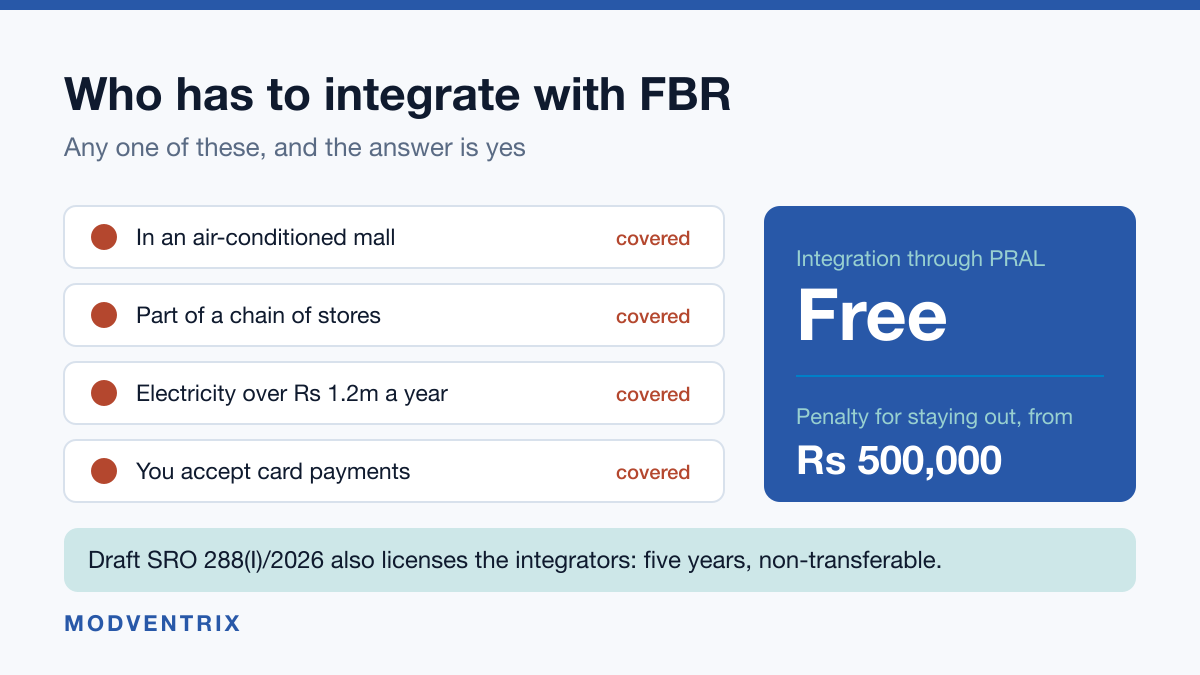
Short answer: if your business is registered for sales tax, FBR expects your invoices to be generated electronically and sent to its system through a licensed integrator before you hand the bill to the customer. The 2026 draft rules widen that net well beyond the large retailers it started with, and PRAL, FBR's own integrator, does it free.
That is the whole rule in one paragraph. The rest of this is the detail that decides what you actually have to do this quarter.
What changed in 2026
FBR issued a draft notification, SRO 288(I)/2026, dated 18 February 2026, which adds a chapter called "Online Integration of Businesses" to the Income Tax Rules. It covers electronic invoicing, POS integration, QR codes on invoices, real-time reporting of sales, a licensing regime for the companies that connect you, and penalties for staying outside it.
Two parts matter more than the rest. First, no supply is to be made except through an integrated outlet or point of sale, which turns integration from a reporting obligation into a condition of selling. Second, nobody may integrate your business unless they hold a five-year, non-transferable licence from the Board, which rules out the informal "my cousin's software house will handle it" route that many shops were counting on.
It was still a draft when this was written. Draft rules change. Check the current status with your tax adviser before you spend money on compliance.
Does this apply to my shop?
The original Tier-1 definition is still the clearest test, and most shops know immediately whether they fall inside it. A retailer is Tier-1 if any of these are true:
- You operate in an air-conditioned shopping mall, plaza or centre, excluding kiosks.
- You are part of a national or international chain of stores.
- Your electricity bill exceeded PKR 1.2 million over the last twelve months.
- You accept payment by debit or credit card.
That last one catches far more shops than owners expect. If you have a card machine on the counter, read the rule rather than assuming it is for the big chains.
The 2026 direction of travel is wider still: the draft language reaches every sales tax registered person rather than Tier-1 retailers alone. If you are registered for sales tax, plan on being covered.
What does integration cost?
PRAL, FBR's own licensed integrator, provides integration and sandbox testing free of charge. That is the floor, and for a single shop with straightforward billing it is often the whole answer.
Above that, costs come from two places and neither is the integration itself. The first is your software: if your current billing system cannot produce an electronic invoice in the required format, you are paying to replace or extend it. The second is the work around it, mostly cleaning up your product and tax data so that what you transmit is accurate. Private integrators charge for convenience and support, not for access.
Budget for the data work. It is the part every shop underestimates, and it does not go away whichever integrator you pick.
What happens if I do not integrate?
Penalties sit in two laws. Under the Sales Tax Act, 1990, failure to integrate attracts a penalty starting at PKR 500,000 under section 33. Under the Income Tax Ordinance, selling outside an integrated system can draw action under section 182, alongside business restrictions, and for Tier-1 retailers the long-standing consequence has been a cut in allowable input tax adjustment to 60%, which is a quiet, permanent tax on staying out.
The input tax reduction is the one that actually hurts. A fine is a single event you can argue about. Losing 40% of your input adjustment is a cost on every month you trade.
What to do this month
- Find out whether you are sales tax registered, and whether any Tier-1 test applies to you. Your accountant knows in thirty seconds.
- Ask your current software vendor one direct question: can it generate an electronic invoice and transmit it to FBR through a licensed integrator today, yes or no. Vague answers are answers.
- If the answer is no, start with PRAL rather than a paid integrator. Free is the right price for finding out how much work your data needs.
- Clean the data before the deadline, not during it. Product names, tax rates and your own registration details are what get rejected.
- Keep the paper trail. Whatever you file, keep your own copy of what was sent and when.
Where Modventrix stands on this
Plainly: Modventrix does not file your invoices with FBR's digital invoicing system today. Your bills carry your business details, your tax and your branding, and they are stored so you can find any of them later, but the transmission to FBR is not something we do for you right now.
We are saying that here rather than letting you find out after you have paid. If FBR integration is the reason you are shopping for software this month, tell us on WhatsApp before you buy, and we will tell you honestly where this sits rather than selling you a trial you will cancel.
What we can do is the part that makes integration survivable whenever you do it: one clean product list, consistent tax handling, and every bill in one place rather than three. The shops that struggle with FBR integration are almost never struggling with the integration. They are struggling with four years of inconsistent data.