
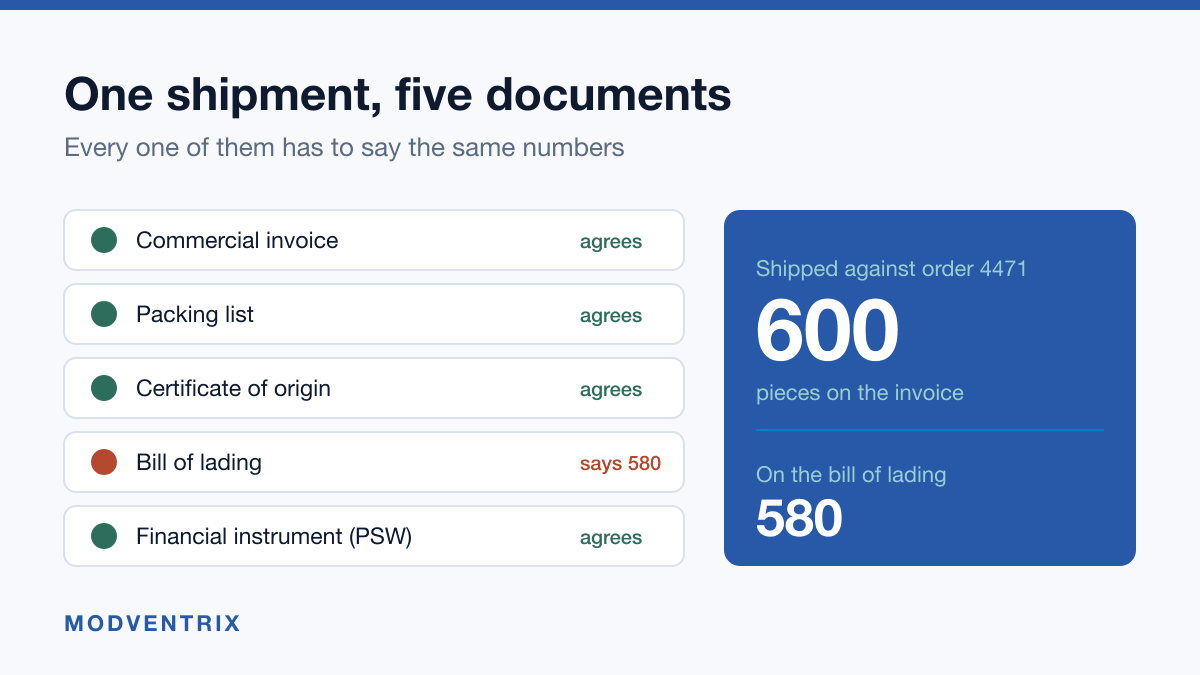
Short answer: one shipment produces a commercial invoice, a packing list, a certificate of origin, a transport document such as a bill of lading or air waybill, and the financial instrument your bank issues through Pakistan Single Window. Quantity, value, description and HS code must be identical across all of them. A mismatch is not a customs problem first. It is a payment problem.
Why the numbers drift
Nobody sets out to put two different quantities on two documents. It happens because the documents are produced at different moments by different people.
The invoice is typed when the order is confirmed. The packing list is written when the cartons are actually packed, which is after QC pulled some pieces out. The transport document is filled from whatever the forwarder was told on the phone. Three sources, three moments, one shipment.
If 20 pieces were rejected at checking on the morning of packing, the packing list knows and the invoice does not. That is the whole mechanism, and it is why the fix is a single source for the numbers rather than more careful typing.
The five documents
Commercial invoice. Buyer, seller, quantity, unit price, total value, currency, terms of delivery, HS code. This is the document the bank and the buyer both read, so it is the one every other document gets compared against.
Packing list. Carton count, net and gross weight, dimensions, and what is in each carton. It must reconcile to the invoice quantity exactly. The buyer's warehouse checks against this, not against your invoice.
Certificate of origin. Issued by a chamber of commerce. It states the goods were made in Pakistan, which is what gives your buyer their duty treatment at their end.
Transport document. Bill of lading for sea, air waybill for air. Issued by the carrier or forwarder from what you gave them, which is precisely why it is the document that most often carries the stale number.
Financial instrument. Your bank issues this through Pakistan Single Window against the consignment, and it is how the State Bank tracks that the foreign exchange comes back. Note that PSW eliminated the separate Electronic Import Form and Electronic Form E, replacing them with electronic trader profiles exchanged between the agencies, so the paperwork you may remember from WeBOC is not what you will meet today.
What has to match, exactly
| Field | Appears on |
|---|---|
| Quantity | Invoice, packing list, transport document |
| Description of goods | All five |
| HS code | Invoice, transport document, customs declaration |
| Value and currency | Invoice, financial instrument |
| Consignee name and address | All five |
| Gross and net weight | Packing list, transport document |
Surgical and medical instruments sit under HS heading 9018. Get the code right at the quotation stage, not at the port, because the code drives your buyer's duty and changing it later means amending documents that have already been issued.
What goes wrong, in order of frequency
Quantity drift after QC. Pieces rejected on packing day never make it back to the invoice. The container ships 580 against an invoice for 600 and the bank holds the payment while you amend.
Description mismatch. The invoice says "surgical scissors", the certificate of origin says "surgical instruments". Both are true, neither matches, and somebody at the other end has to accept a discrepancy.
Weights invented for the forwarder. Estimated gross weight on the transport document against actual weight on the packing list. Small discrepancies get waved through until the one time they do not.
Partial shipment with full paperwork. You ship 400 of 600 because the rest is still with an outworker, but the invoice was already typed for the full order. Partial shipments need their own document set, not an edited copy.
The habit that prevents all four
Produce every document from the same record of what actually shipped, and produce them after packing rather than before.
That sounds obvious and almost nobody does it, because the invoice is typed early to keep the buyer happy and nothing forces it to be revisited. The discipline is simple: packing is what closes the numbers. Nothing is issued final until the cartons are sealed and counted, and whatever changed at QC changes the invoice before it changes nothing at all.
If you ship partials routinely, keep one order and many shipments rather than copying the order. Each shipment carries its own quantity, its own documents and its own payment, and the order tells you what is still owed to the buyer.
Before your first export shipment
Registration, roughly in order: an NTN and sales tax registration with FBR through Iris, a registration in Pakistan Single Window with your bank profile associated, membership of your trade association, SIMAP for surgical instrument makers, and membership of a chamber of commerce, which is also who issues your certificates of origin. Your bank and your clearing agent will both tell you their own requirements, and those are the ones that stop a shipment in practice.
Rules change. Confirm the current list with your bank and your clearing agent before you commit to a shipping date rather than after.
Where Modventrix fits
One order, many shipments, with each shipment carrying what was actually packed. The quantity on the paperwork comes from the same record as the stock movement, so a reject at checking cannot quietly leave the invoice saying 600.
We have also written about tracking the production side, where the pieces are before they reach packing, which is usually the reason a shipment goes partial in the first place.