
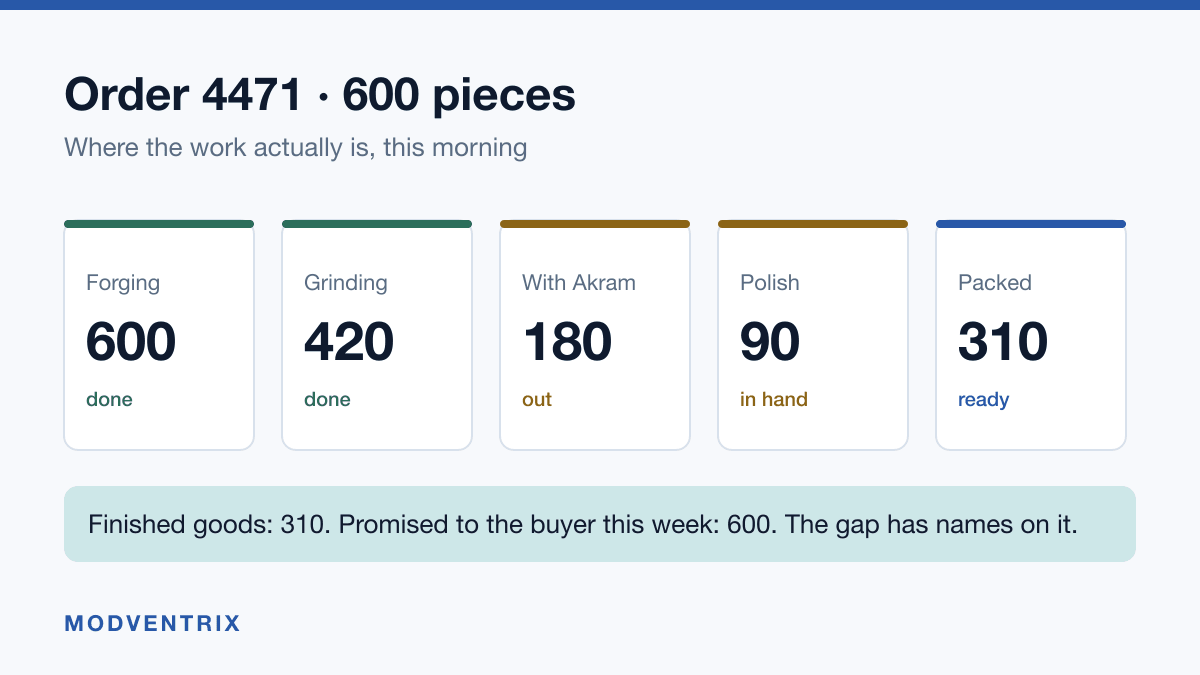
Short answer: count the order at every stage it passes through, not just at the end. One order, one row per stage, with the quantity that has cleared it and the name of whoever is holding the rest. Finished goods is then a number you can ship from, and everything else is visible without being counted as stock.
Most units in Sialkot track the first and last number: pieces ordered, pieces packed. Everything between those two lives in a diary, a phone call and somebody's memory. That works until the buyer asks what is ready, and nobody can answer without walking the floor.
Why a stock count does not answer the question
A surgical order is not a thing you hold. It is a thing in motion.
The same 600 pieces are forged, ground, filed, heat treated, passivated, polished, checked and packed, and at any moment they are spread across several of those stages. Some of the stages happen in your unit. Several happen at an outworker's, which means the pieces are physically not in your building at all.
Count your shelves and you get a number that is true and useless. It does not tell you what you can ship, because most of the order is not on the shelf, and it does not tell you what is at risk, because a pile of ground pieces and a pile of packed pieces look the same in a total.
The format that works
One row per stage of the order, in the sequence the work actually runs:
| Stage | Who holds it | Cleared | Still out |
|---|---|---|---|
| Forged | In house | 600 | 0 |
| Ground | In house | 420 | 180 |
| Filed and finished | Akram, outworker | 180 | 180 |
| Polished | In house | 90 | 330 |
| Checked | QC | 310 | 290 |
| Packed | Packing | 310 | 290 |
Read it bottom up and you know what you can ship today: 310. Read it top down and you know where the other 290 are, and whose phone number you need.
Two rules make this survive contact with a real workshop. Record the quantity that cleared a stage, not the quantity sent into it, because sent is a promise and cleared is a fact. And give every outworker a name in the system rather than a category, because "with the polisher" is not actionable when you use four.
Work in progress is not stock
This is where most systems in the trade go wrong, including some expensive ones.
If a half-finished piece sits in your stock count, your stock figure is a fiction. It says you hold 600 when what you can actually ship is 310. Decisions made on that number are wrong in a specific direction: you accept a delivery date you cannot meet.
Keep the two apart. Work in progress is counted by stage and by holder. Finished goods is counted on the shelf and is the only number allowed to say what you can ship. The gap between them is not a problem to hide, it is the single most useful number in the unit, because it has names and dates attached to it.
Rejects are information, not loss
Every stage loses pieces. A reject at checking is worth recording against the stage it failed at and the person who did that stage.
Do that for three months and you stop arguing about quality in general terms. You know that one outworker returns 4% rejects and another returns 11%, and you know what that 7% costs you per thousand pieces. That is a conversation you can have with numbers rather than with a raised voice, and it usually ends with better work rather than a lost supplier.
Record rejects as their own movement, with a reason. Not as a quiet adjustment to the count, because an adjustment with no reason is how a unit loses the ability to explain its own numbers.
What this changes on the buyer call
When the buyer asks for a status, you are answering from a table rather than a memory:
- 310 packed and ready to ship.
- 180 with Akram, promised back Thursday.
- 90 in polishing, two days.
- 20 rejected at checking, being remade.
Say that and the buyer reschedules. Say "it is nearly ready" and the buyer stops believing you, which costs more than the delay.
Where Modventrix fits
Processes in Modventrix are the shop floor stages, each with a named worker, and they sit alongside the stock count rather than inside it. A piece out with an outworker is visible and is not counted as finished goods. A buyer revision is recorded against the original order, so what changed, what was already made and what still has to be bought stay three separate answers.
If you want the product version of this, it is on our page for surgical and made-to-order manufacturers. If you would rather build it in a spreadsheet first, the table above is the whole design and we have written up how to keep that sheet properly.